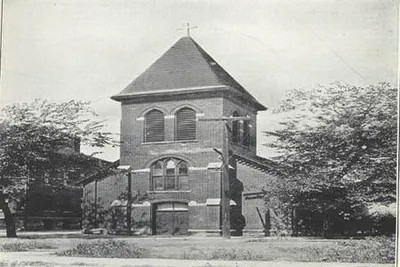
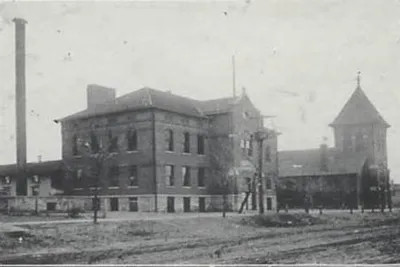
St. Wenceslaus was founded in 1874 with the original church, since demolished, being built in 1882. A grade school, demolished in 1888, was added in 1893. The current church was built in 1904 and the current rectory in 1910. A high school building was opened in 1921 with the gymnasium and auditorium being added in 1926. In 1926 the high school became the first Czech parish high school in the United States to be fully accredited. The high school closed in 1958; the grade school closed in 1969. St. Wenceslaus is designated as a personal parish to minister to the Czech speaking peoples of the Archdiocese.
Humble BeginningsIn 1874, the St. Wenceslaus Catholic Parish was established and a church built. The parish started slowly, with sixty families at first. But within three decades, it had grown to 1200 parishioners. In 1904, a substantial new church was built to replace the old structure which was later torn down. In 1879, a house for the pastor was added; it was replaced with the current structure in 1910. |
 |
 |
The NeighborhoodThe neighborhood around the St. Wenceslaus Parish campus was originally settled by Czechoslovaks (or Bohemians) who began to arrive in Cedar Rapids in the early 1850’s. Even greater numbers arrived after the Civil War and the end of the Prussian War in Austria in 1880. By the end of the century, Bohemians had become well represented in elected positions in local government and the city’s bustling economy. Initially they populated the city’s south side neighborhood east of the Cedar River but later also populated the west side directly across the river. Eventually hundreds of homes were built. |
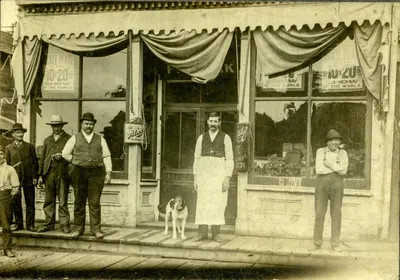
LivelihoodThe Bohemians worked in nearby businesses, small factories, and larger industrial sites such as the J. G. Cherry Company, the Carmody Foundry, and the Sinclair Company meat packing plant. As the population grew, many of the Bohemians opened their small businesses, often in the lower level of a building while they and their family resided in the upper level. The properties were well kept, and usually included flower gardens and vegetable patches. A bank was established with the primary purpose of providing mortgage loans to the Bohemian population. A bridge was constructed to connect the east and west sides of the river. And a streetcar line was run to connect the Bohemian neighborhood to the main Cedar Rapids business district to the north. |
 |
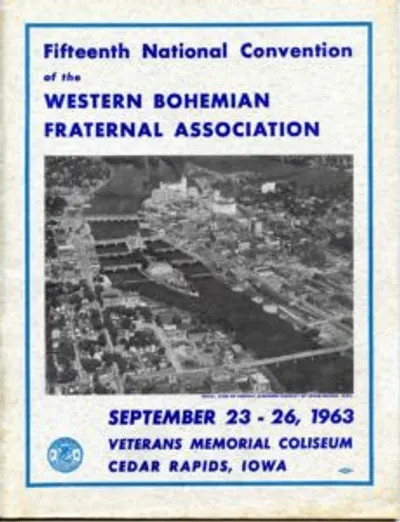 |
Social InstitutionsBohemian social institutions were established and grew along with the population. The immediate neighborhood was home for the Czecho-Slovak Protective Society (CSPS), the Western Bohemian Fraternal Association (ZCBJ), and a Czech Language School. The buildings housing these organizations still exist in the southeast side neighborhood. although they have been converted to different uses. Several Bohemian churches were established. The St. Wenceslaus Catholic Church was the first and the largest. |